The Architecture of Absolute Solitude
Looking out at the unrelenting, miserable gray drizzle of the Frankfurt skyline right now, my screen casting an obnoxious blue glare over a cup of espresso that went entirely cold three hours ago, I realize that Western sociologists completely misunderstand the absolute collapse of romantic relationships in East Asia. It is arrogance. We arrogantly pretend that the sudden explosion of single-seat restaurants and solo-karaoke booths in Tokyo and Seoul is just a quirky lifestyle trend for introverts, completely ignoring the brutal reality that these spaces are actually the physical manifestation of a massive, silent rebellion against the terrifyingly oppressive economic expectations of traditional marriage. They are striking. (Maybe I’m overthinking this, but it truly infuriates me how American media constantly infantizes East Asian culture, treating a profound demographic crisis like it’s just a cute aesthetic choice for TikTok influencers.) It is sickening. Right now, on the ground, the only thing that moves the needle for a generation completely crushed by stagnant wages and astronomical housing costs is a total, unapologetic rejection of the family unit. Marriage is dead.
When you actually look at the undeniable financial wreckage left behind by these hyper-competitive corporate structures, it becomes painfully obvious that the traditional pathway to forming a household is currently collapsing under the weight of spectacular systemic greed. It is over. On Friday, March 13, 2026, the S&P 500 closed at a brutal 6,632.19 amidst a terrifying wave of global inflation panic, reflecting an exhausted consumer base that can no longer justify the massive financial black hole required to fund a traditional courtship, let alone a wedding or a child. Wallets are empty. Stop being broke and stuck paying ridiculous premiums for couple-oriented dining experiences or aggressively saving for a down payment on a microscopic apartment that you will never actually afford, because the data clearly shows a massive youth exodus toward the highly optimized, financially predictable comfort of absolute solitude. They quit trying. (Honestly, I laugh at these aging politicians who raise millions in tax incentives claiming they have a magical solution for the birth rate, when they clearly have never experienced the deeply irrational, gravity-defying stress of trying to survive on a starting salary in Gangnam.) They are clueless.
The “Ohitorisama” Evolution and “Honbap” Isolation
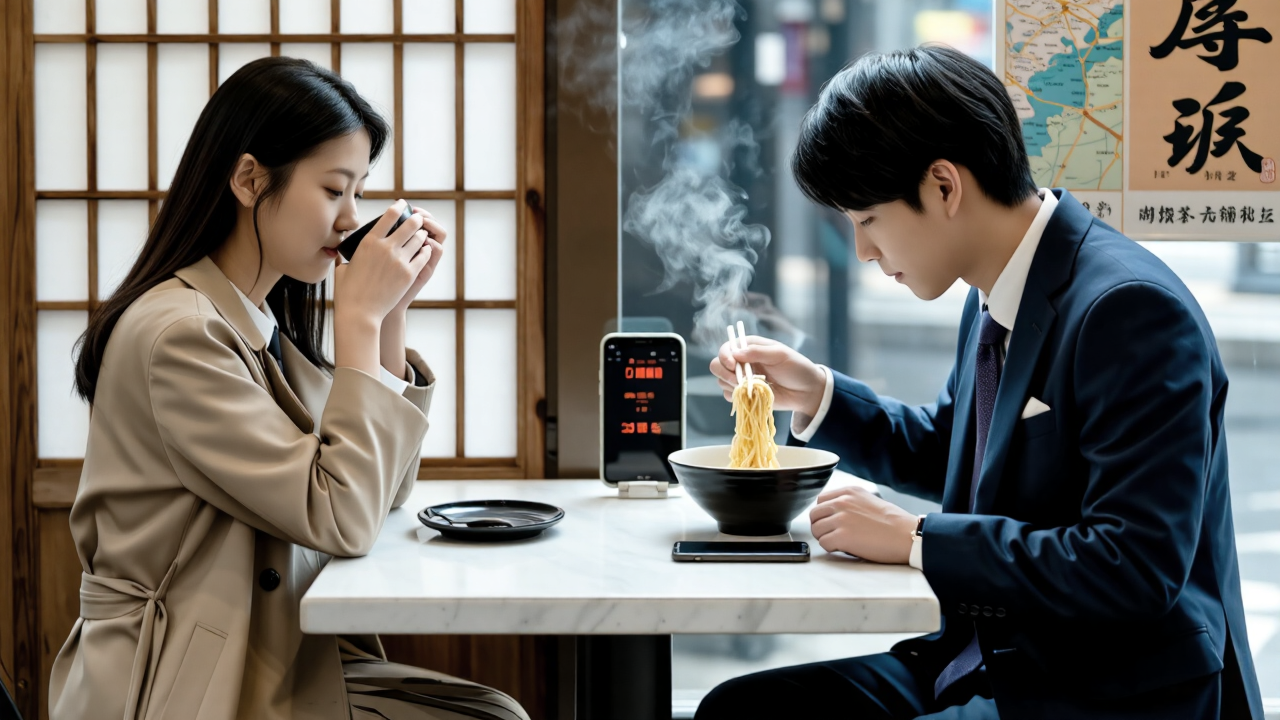
Japan initiated this quiet revolution decades ago with the “Ohitorisama” — the art of doing things alone — movement, but South Korea has recently violently escalated the concept through “Honbap” (solo dining), transforming the deeply communal act of eating into a highly efficient, walled-off exercise in biological refueling that intentionally completely severs any possibility of unwanted social interaction. Silence is golden. If you walk into a modern Ichiran ramen shop in Shinjuku, you are instantly funneled into a highly engineered, wooden isolation booth where you interact solely with a pair of disembodied hands sliding a bowl through a tiny curtain, totally stripping away the exhausting performative anxiety of eating in public. It is perfect. We have reached a terrifying inflection point in 2026 where the physical environment of our major metropolitan centers is no longer just accommodating single people, but actively colonizing public spaces to ensure that you can easily live an entire, functioning adult life without ever actually speaking to another human being. The city isolates.
The sheer architectural genius of these modern solo-dining establishments lies in their ability to seamlessly integrate the psychological need for physical nourishment with the absolute refusal to compromise on personal space, providing a brilliant emotional safety net that appeases our biological hunger while completely starving our souls. We are empty. You cannot outsource your boundaries to a tiny wooden dining partition without actively surrendering your own human agency, allowing a restaurant floor plan to systematically eliminate the beautiful, serendipitous accidents that historically led to the most profound interpersonal connections. The accidents matter. (Maybe I’m overthinking this, but I am utterly convinced that handing over the most vulnerable, intimate decisions of our human existence to a piece of proprietary restaurant seating software is the fastest route to collective emotional bankruptcy.) It is terrifying. We desperately treat the physical world as a disposable waiting room for our digital interactions, completely ignoring the tangible, beautiful chaos that used to occur over a shared meal in our frantic search for a perfectly curated, completely unbothered existence. Look up.
The Heterosexual Strike in Seoul
If you want to understand the profound ethical rot at the center of the modern East Asian dating market, you have to look past the slick corporate marketing of single-life products and realize that the women of Seoul are actively organizing a catastrophic, highly effective boycott of men entirely. Anger drives this. They simply use or tap into the fierce ideological framework of the “4B” movement — which explicitly mandates the complete rejection of dating, sex, marriage, and childbirth with men — as a messy plan that works surprisingly well to protect their own sanity and financial independence from a deeply entrenched patriarchal system that demands their total subjugation. They are exhausted. It infuriates me that conservative analysts are only now acting surprised that financially independent women absolutely refuse to sign a legally binding contract that guarantees them a lifetime of unpaid domestic labor and a permanently derailed career. Independence wins out.
The monolithic tech companies and panicked government agencies are currently desperately scrambling to integrate artificial intelligence features into their failing, state-sponsored dating applications, completely missing the blindingly obvious fact that their angry citizens are fleeing precisely because the marriage market already feels entirely artificial and intensely transactional. Algorithms are useless. You cannot mathematically optimize human vulnerability, and no amount of algorithmic tweaking or state-funded cash bonuses is going to convince a broke, exhausted twenty-something to trust a societal structure that spent the last forty years aggressively monetizing their deepest personal insecurities and extracting every ounce of their physical labor. The damage remains. Decades of harsh corporate reality confirm that romantic desire operates entirely like a chaotic, unpredictable earthquake, heavily reliant on a sense of hope and safety that has been systematically eradicated by the absolutely crushing demands of the modern Asian workplace. Hope is gone.
Capitalism’s Embrace of the Single Consumer
The sheer arrogance of assuming that the free market actually wants to solve the loneliness epidemic is a testament to how profoundly disconnected we have become from our own economic reality, because the absolute truth is that corporate conglomerates are actively profiting off of this extreme societal atomization. Loneliness pays well. When an entire demographic suddenly stops buying family-sized minivans or bulk groceries and instead shifts their spending toward aggressively overpriced, individually packaged convenience store meals and premium solo-travel packages, it ceases to be a demographic tragedy and instantly becomes a highly lucrative, infinitely exploitable new revenue stream. Greed blinded them. (Honestly, any economist who tells you that corporate Japan is terrified of the declining birth rate is either completely lying to you or has never actually looked at the staggering profit margins on single-portion luxury goods and solo entertainment booths.) They love it.
This creates a deeply unsettling self-fulfilling prophecy where the corporate infrastructure actively rewards your isolation, offering a frictionless, hyper-convenient alternative to the terrifying, magnificent responsibility of choosing a partner and building a shared, messy life. Friction is essential. They sell the illusion that your perfectly curated solo apartment, your single-serving meal kits, and your heavily filtered digital entertainment can successfully replace the warmth of human intimacy, completely ignoring decades of rigorous psychological research proving that prolonged isolation literally deteriorates the human brain. Science proves this. We eagerly trade the acute, necessary pain of a real-life romantic rejection for a low-grade, perpetual depression that slowly rots our self-esteem while enriching the exact same corporations that destroyed our work-life balance in the first place. The screen isolates.
The Demographic Death Spiral
Watching politicians try to build a sustainable demographic future upon the sterile foundation of tax credits and panicked propaganda campaigns is like watching someone try to grow a towering oak tree in a sealed, climate-controlled laboratory — the environment is completely devoid of the natural friction, economic stability, and unpredictable hope required to create deep, resilient roots. The setup is doomed. Stop being broke and stuck in the mindset that human psychology operates on a single track of perpetual growth, because the reality is that the emotional boundaries of the East Asian youth are completely manufactured by the unspoken, suffocating rules of the concrete soil they happen to be standing on. Geography wins again. As we survive the crushing economic realities of 2026, we have to aggressively accept that human love is simply not enough to bridge the massive, terrifying gap between a culture that demands constant, fiery corporate servitude and a generation that views absolute solitude as the ultimate expression of freedom. Love is conditional.
(Maybe I’m overthinking this, but… seeing the same destructive patterns repeated across the globe makes me question if we actually possess free will when it comes to love, or if we are just blindly executing the late-stage capitalist scripts our employers hardwired into our bank accounts.) We are ghosts. The harsh truth that nobody in the lucrative matchmaking industry wants to admit is that sometimes a society doesn’t fail to reproduce because of a lack of effort; it fails because a weary soul and an exhausted heart are trying to run two completely different, fundamentally incompatible operating systems on the exact same broken hardware. Crash is inevitable. We wander through these pristine, perfectly silent single-occupancy noodle shops hoping for a sudden miracle, but perhaps the only real mercy left is recognizing when the cultural chasm is simply too wide to jump. I am done.