
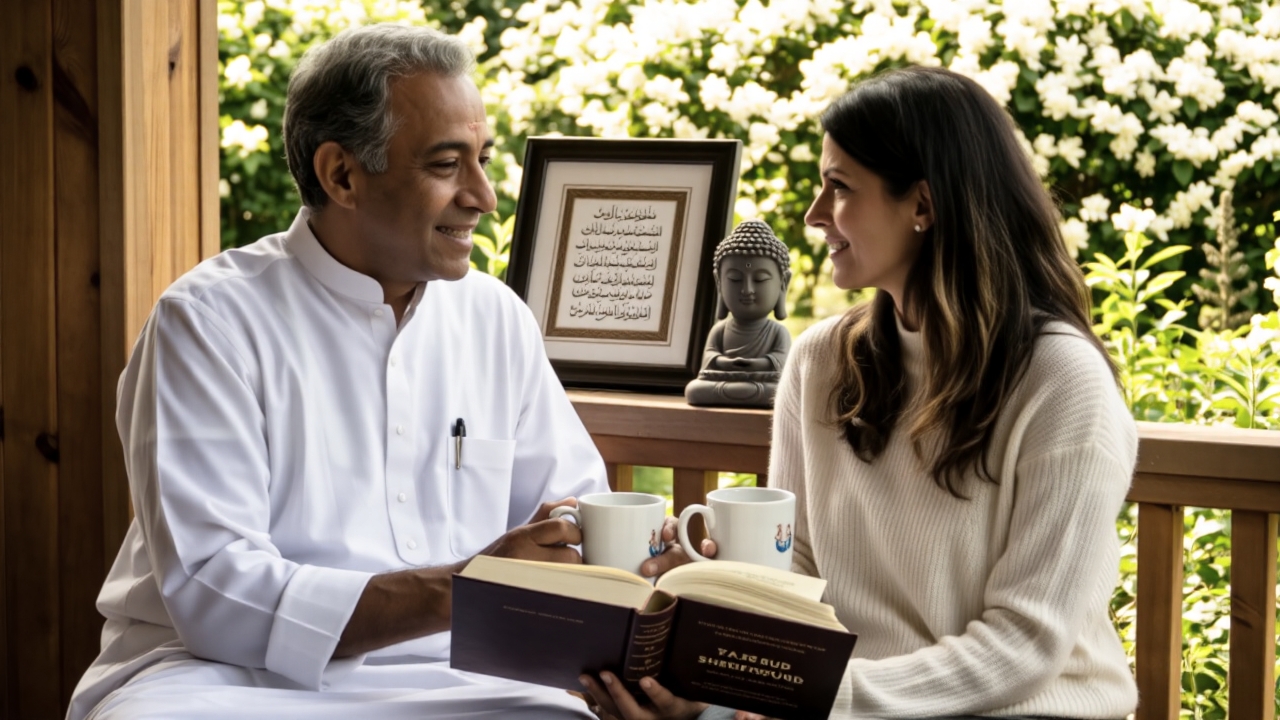
The Romance Trap of the Unequally Yoked
Right now, on the ground, we are witnessing an entire generation of optimistic couples blindly walking into a lifelong psychological meat grinder because they mistakenly believe that modern affection can simply overwrite thousands of years of deep-seated human instinct regarding the eternal soul. They are wrong.
The cultural narrative insists that love is enough to conquer absolutely anything, completely ignoring the terrifying reality of waking up every single morning next to someone who thinks your deepest convictions are absolute fiction. According to the February 2025 Religious Landscape Study by the Pew Research Center, 26 percent of married adults in the U.S. report that their spouse has a religious identity different from their own. Specifically, 13 percent of married U.S. adults who are Christians are paired with a religiously unaffiliated spouse, or vice versa.
(Maybe I am just chronically cynical about romance, but pretending that a shared love for obscure indie movies somehow negates a fundamental disagreement on the origin of the universe seems like a catastrophic miscalculation…)
People are throwing themselves into these unions with zero regard for the actual mechanics of a shared life. A recent Pew analysis indicates that roughly 29 percent of Americans are now religiously unaffiliated, a demographic shift that guarantees this collision of worldviews will only accelerate. The sheer arrogance required to assume you can just casually merge two entirely incompatible realities without massive collateral damage is staggering.
The Invisible Tax on Daily Reality
When an atheist marries a believer, the initial dating phase acts as a powerful narcotic that masks the structural cracks in the foundation. You assume the differences are just quirky personality traits, a minor hurdle that a messy plan that works will easily fix over time.
But you cannot split the difference on whether an omnipotent deity is actively judging your Tuesday afternoon.
If you genuinely believe your partner is headed for eternal darkness while they simultaneously view your most cherished spiritual beliefs as nothing more than a childish psychological crutch designed to cope with the terrifying randomness of existence, your marriage is fundamentally built on a foundation of mutual pity. It is doomed.
I am typing this from a claustrophobic cafe in Frankfurt, watching the miserable gray rain aggressively lash against the windowpanes while the neon sign across the street flickers with an obnoxious, stuttering rhythm. I just finished reading the March 10, 2026 financial dispatches about how Wall Street is panicking over Nvidia’s upcoming GTC conference, specifically how their roadmap for “Agentic AI” architectures is actively colliding with a severely strained global energy grid. We literally cannot even align our technological ambitions with our physical electricity constraints, yet we arrogantly demand that two humans with entirely different metaphysical operating systems flawlessly align their souls.
(Sitting here shivering in this absurdly overpriced German coffee shop, I realize my own bias is bleeding into this analysis—but frankly, unbiased relationship advice is usually just cowardly garbage anyway…)
The Myth of “Shared Values”
The most infuriating defense of the atheist-believer marriage is the desperate, hollow claim that “we share the same core values.” This is a linguistic parlor trick.
It completely ignores the reality that morals derived from an absolute divine command behave very differently under extreme psychological stress than ethics derived from humanistic, secular pragmatism. The believer views morality as a sacred obligation owed to a higher power, whereas the atheist views it as a social contract required to keep society from collapsing into chaos.
When the devout partner desperately attempts to instill a sense of divine purpose in their child while the atheist partner simultaneously deconstructs that exact same narrative using secular rationalism, the resulting psychological friction inevitably transforms the family living room into a permanent, exhausting ideological warzone. Nobody wins.
Couples who attempt to use/tap into generic, watered-down spirituality to bridge this gap always end up creating a sterile environment that satisfies absolutely no one. You do not achieve peace; you just mandate silence.
Raising Children in a Metaphysical Void
The absolute breaking point for these marriages almost always arrives the moment the first child is born. The theoretical debates of your twenties instantly become the terrifying, high-stakes parental decisions of your thirties.
According to psychological data on interfaith relationships, when couples share the same religion, 77 percent are highly involved in religious practices like praying and attending services. However, this religious involvement violently plummets to a mere 13 percent for couples where one partner is religious and the other is totally unaffiliated.
The religious partner is systematically suffocated by the atheistic gravity of the household.
(I honestly wonder if couples who claim to perfectly balance atheism and devout faith are just quietly lying to themselves to avoid the terrifying prospect of dying alone… The statistics certainly suggest they are faking it.)
Children demand absolute clarity, but these households can only offer them a confusing, contradictory void where dad prays to God and mom says God is a fairy tale. You want to stop being broke and stuck in a perpetual state of theological gridlock, but you literally cannot compromise on the existence of heaven.
The Illusion of Sunday Morning Compromise
The secular world loves to celebrate these marriages as triumphs of modern tolerance, viewing the secular-religious pairing as the ultimate proof that human connection transcends ancient dogma. This is a patronizing, incredibly naive viewpoint.
The brutal reality is that couples who manage to survive this specific chasm do not do so by finding some magical middle ground where God only sort of exists on alternating weekends, but rather by accepting a permanent, aching loneliness within the most intimate corners of their own marriage. You die alone.
If the believer cannot share their most profound spiritual encounters with their spouse, and the atheist cannot share their stark, existential awe of the cosmos without offending their partner’s deeply held theology, then what exactly are they sharing? They are just roommates who split the mortgage and occasionally hold hands.
The Only Thing That Moves the Needle
Couples therapists charge exorbitant hourly rates to sit in plush armchairs and suggest that active listening and “respecting boundaries” will somehow fix a fundamental disagreement on the literal nature of reality. They are selling snake oil.
The only thing that moves the needle in an atheist-believer marriage is a radical, painful acceptance that a massive portion of your partner’s internal world will forever remain entirely inaccessible to you.
You have to actively mourn the fact that you will never fully know the person sleeping next to you.
(Does anyone actually believe that romantic love is a sufficient substitute for spiritual solidarity? My cold coffee and the depressing Frankfurt weather are heavily inclining me toward a solid ‘no’.)
We keep throwing ourselves into these contradictory relationships because the sheer terror of modern isolation overrides our logical survival instincts, forcing us to violently jam puzzle pieces together that were blatantly manufactured for different games entirely. People are desperate, grasping at any form of intimacy, even if it requires them to constantly apologize for their own soul.
So the atheist sits quietly through the baptism, biting their tongue to keep the peace, while the believer stares at the ceiling late at night, silently weeping out of fear for their partner’s eternal damnation. They just keep pretending the silence means everything is fine.