
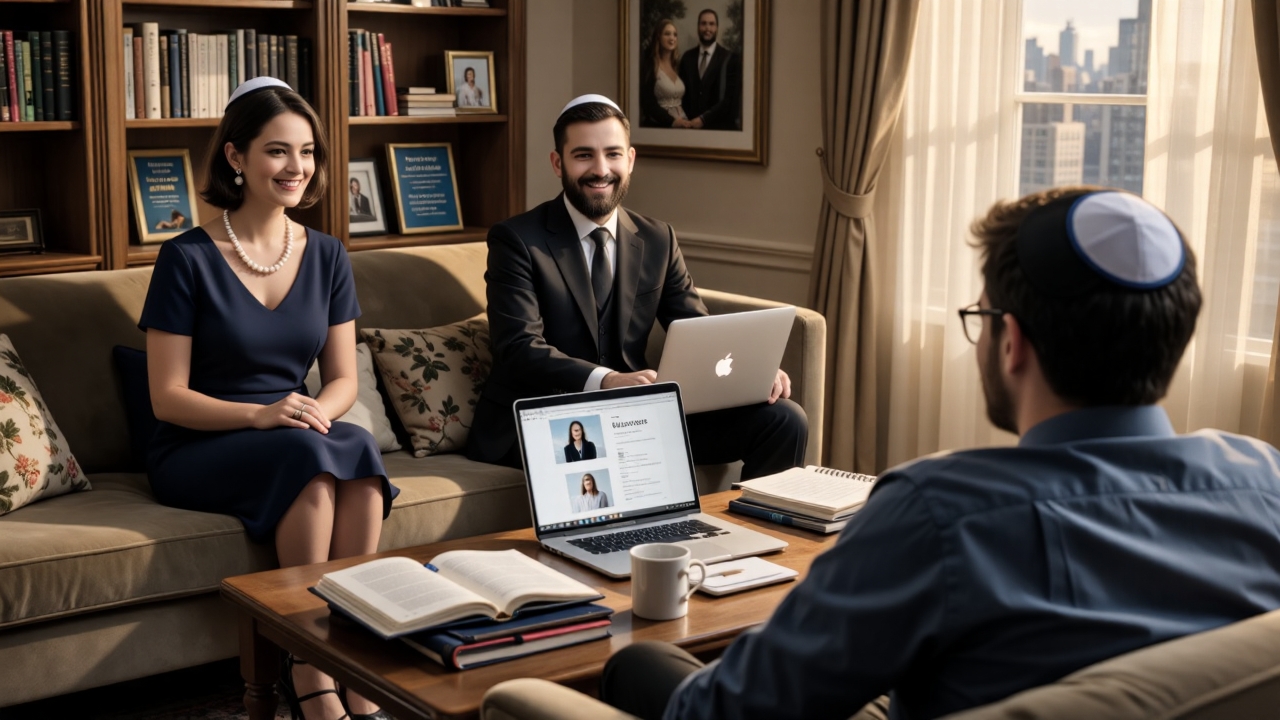
The Resume Sits at the Bottom of the WhatsApp Chat
Orthodox Jewish matchmaking in the modern city is entirely broken, functioning less like a sacred tradition and more like a digitized, hyper-critical meat market. We need to face the fact that the shidduch system, originally designed to carefully pair families in tight-knit European villages, is collapsing under the weight of 2026’s urban isolation, digital excess, and a profound cultural shift toward individual autonomy.
It is a complete disaster.
Right now, on the ground, the system is actively harming the people it claims to help. According to the July 2025 Nishma Research survey, women rate the Orthodox dating landscape a dismal 4.0 out of 10. I am sitting in a cafe in Frankfurt right now, watching the cold, gray rain smear against the window while the flickering light of my laptop screen illuminates yet another PDF “shidduch resume” forwarded by a well-meaning aunt from New York. My coffee has gone completely cold.
(Maybe I’m projecting my own exhaustion here, but seeing human lives reduced to height, seminary attended, and a father’s occupation makes me want to throw my phone directly into the river…)
Let’s drop the polite fiction. The communal mediation that once protected singles has morphed into a brutal vetting process where people are discarded before they ever speak. It’s cruel.
The Illusion of Infinite Choice
We have more ways to meet than ever before, yet singles are statistically lonelier and vastly more frustrated. The community has decided to use/tap into a myriad of WhatsApp dating chats, sprawling databases, and even AI algorithms like the ‘Algo’ bot—which asks 84 detailed personality questions to spit out a supposedly perfect match from a digital database.
But this digital scale just creates the illusion of infinite options, paralyzing daters who suddenly feel they can wait for the flawless aesthetic match while plunging women into a brutal demographic bottleneck. This is widely known in communal leadership circles as the “age squeeze,” where women in their twenties think they have plenty of time, only to discover in their thirties that men their exact age strictly prefer to date much younger women. The men get cocky, and the women get waitlisted. It’s an infuriating dynamic that penalizes women for the crime of simply existing past age 24.
The sheer volume of potential matches theoretically available through these digital platforms should logically result in faster, more compatible marriages, but instead, it traps singles in an endless, agonizing loop of swipe-fatigue where every potential flaw is magnified and no one is willing to commit to a second date because the phantom of a slightly better option is always hovering in the next unread text message.
Nobody commits.
(Am I the only one who thinks that treating human connection like a corporate supply chain is fundamentally anti-romantic? Probably not.)
The Shadchan is Failing the Urban Single
Matchmakers—shadchanim—were supposed to be the empathetic bridge in this chaotic ecosystem. Instead, many have become rigid gatekeepers to an exclusive club nobody actually enjoys being part of.
A comprehensive 2025 study by the Orthodox Union’s Center for Communal Research revealed a quiet, devastating truth: daters feel entirely objectified by a process that strips away their humanity and reduces their spiritual complexities to a single piece of paper. Singles reported intense feelings of anxiety and a lack of support, pointing out that the system focuses far too intensely on superficial components detailed in these resumes.
The traditional practice of insisting that men approve a suggestion prior to a matchmaker even showing it to a woman leaves men with curated lists of women to choose from, while the women just sit and wait to be approved. It’s a bizarre contest where the man is the judge, and the women are placed at a severe, structural disadvantage.
The Emotional Vacuum of the First Date
There is absolutely no organic chemistry allowed in this highly scripted environment. You show up to a hotel lobby, order a kosher beverage, and interrogate each other across a table for exactly two hours.
The expectation in some stricter Haredi circles is not to develop a deep emotional connection during the courtship period at all, but rather only after marriage. This severe lack of emotional discourse makes it incredibly difficult for women to recognize red flags or gauge a partner’s actual motivation to build a life together.
You are flying blind.
Singles don’t want to be matched by a rigid spreadsheet anymore; they just want a messy plan that works. They are completely tired of the polite, sterile interrogations.
The Rebellion of the “Never-Married”
There is a growing, palpable anger among older singles—particularly women past their twenties—who are structurally ignored by the mainstream system. We see an increasing number of Orthodox never-married women who are emotionally healthy and actively seeking a mate, yet find themselves completely sidelined by the community.
By the time an older single woman is fortunate enough to finally get a match suggestion, the available pool is often strictly limited to divorcees and widowers. Why? Because the system rigidly enforces arbitrary age hierarchies. It completely ignores the actual compatibility of two adults in favor of societal optics.
The singles are starting to fight back against this absolute nonsense. They are bypassing the formal shadchanim and demanding that their own friends and family take a more active role in setting them up. In fact, recent data shows that 32 percent of males and 38 percent of females cited their own family and friends as the primary source for their dates, bypassing the professional gatekeepers entirely.
(I honestly wonder if the matchmaking establishment realizes how quickly they are becoming completely irrelevant… The resentment is visibly boiling over.)
Stop Being Broke and Stuck in the Dating Funnel
People are starting to realize that to survive the modern shidduch crisis, you have to break the old rules. The rigid checklist process—where parents dictate what their child supposedly needs rather than what the actual person is looking for—is a total, unmitigated failure.
The modern urban dater is dealing with extreme work schedules, financial burdens, and intensive career development. They don’t have the time or the emotional bandwidth to entertain a matchmaker’s wild guesses based on a resume. They desperately want to stop being broke and stuck in a perpetual state of waiting.
In addition to choice overload, empirical studies on mobile dating in the Jewish world reveal severe dating fatigue, where participating in myriad WhatsApp dating chats leads to total emotional exhaustion rather than any genuine connection. Modern dating platforms emphasize quick visual judgments and incredibly short, superficial conversational exchanges.
This constant performative dynamic drastically increases self-doubt and social anxiety, destroying any chance of building substantial, marriage-minded relationships.
The Only Thing That Moves the Needle
So where does this leave the Orthodox dating scene in 2026? The only thing that moves the needle is entirely abandoning the corporate vetting model of dating.
We have to stop treating unmarried individuals as a community problem to be solved and start treating them as adults who are entirely capable of managing their own lives. Community leaders urge everyone to step up and help singles, suggesting that it shouldn’t just be the job of the matchmaker to facilitate introductions. But honestly, maybe the broader community just needs to back off and let people breathe for a minute.
The modern shidduch system is pathologically obsessed with control—controlling the narrative, controlling the exact timeline, controlling the flow of information between two people who just want to grab a coffee and talk normally. That control is suffocating the very marriages it claims to want to build.
If the community continues to rely on PDF resumes and algorithms to do the heavy lifting of human connection, the dropout rates and the profound loneliness will only accelerate, leaving a brilliant generation of singles staring blankly at their phones, wondering why a system supposedly built on divine intervention feels so painfully, aggressively artificial.