The Era of the Digital Meat Market is Over
Staring out at the relentless, miserable gray drizzle of the Frankfurt skyline right now, my screen casting an obnoxious blue glow over a mug of coffee that went freezing cold three hours ago, I realize that the entire digital matchmaking complex is currently collapsing under the weight of its own spectacular greed. It is dead. We desperately pretend that algorithms can manufacture human connection, but the brutal reality is that mass-market swiping has become a psychological torture chamber designed explicitly to extract monthly subscription fees rather than foster genuine romantic attachment. What a scam. I genuinely despise the tech executives who sold us this lie… a complete disaster of a business model that treats loneliness as an endlessly exploitable natural resource. They ruined love.
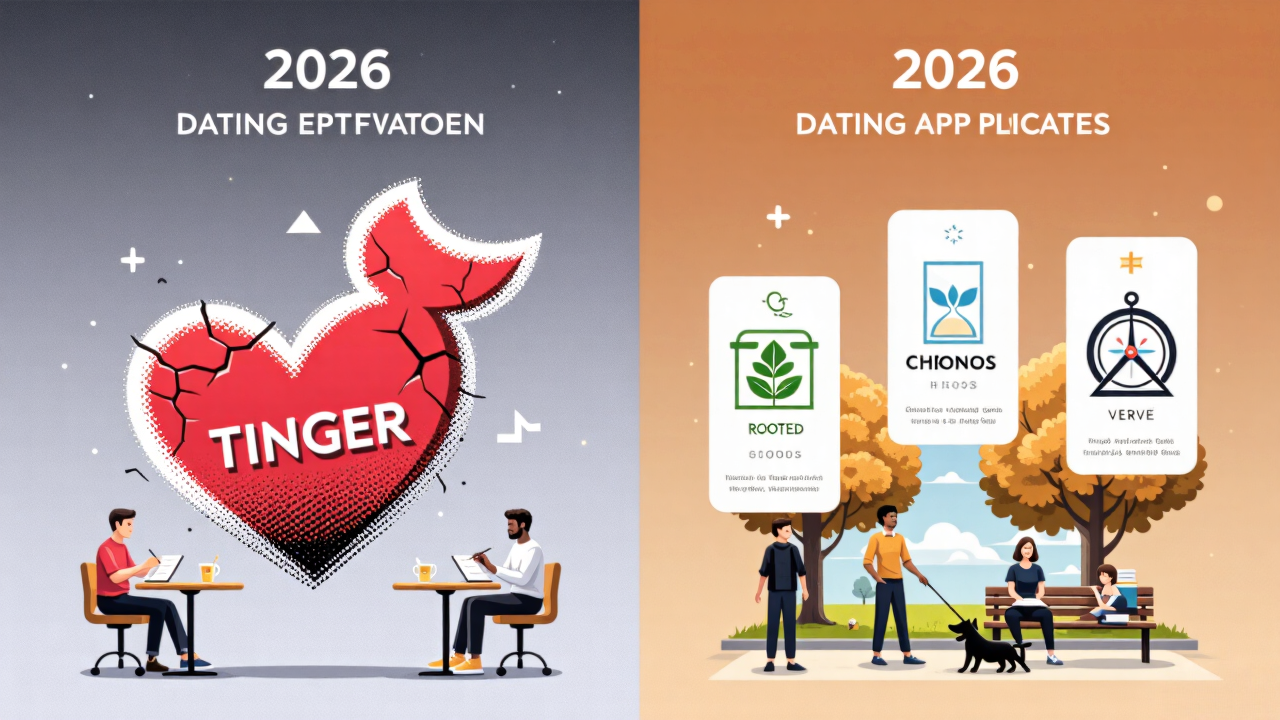
Right now, on the ground, the era of gamified romance is officially over, completely destroyed by a combination of severe macroeconomic pressures and a generation of singles who are completely burnt out on shallow, meaningless digital interactions. Tinder is failing. Stop being broke and stuck paying ridiculous premium fees for platforms that actively hide your profile behind a paywall, because the data clearly shows a massive user exodus toward slower, highly curated niche platforms that force actual conversation. Algorithms are useless. (Maybe I’m overthinking this, but I firmly believe that the very concept of swiping left or right on a human face was always destined to destroy our collective empathy and reduce us to sociopathic window shoppers.) It was doomed.
The Economic Collapse of Gamified Romance
When you actually look at the undeniable financial wreckage left behind by these companies, it becomes painfully obvious that the subscription-based dating model is imploding exactly as the broader market faces a terrifying wave of sustained economic anxiety. They lost everything. On Friday, March 13, 2026, the S&P 500 closed down 1.60% for the week at a brutal 6,632.19, reflecting a terrified consumer base that can no longer justify blowing their shrinking disposable income on useless digital slot machines. Wallets are empty. Bumble stock has suffered a cataclysmic $14.7 billion wipeout, crashing down to a pathetic $2.96 around March 10, while Match Group—the corporate overlord of Tinder and Hinge—plummeted to around $31 as paying users aggressively canceled their memberships in droves. Investors are panicking. It infuriates me that Wall Street analysts are only now acting surprised that financially exhausted people refuse to pay twenty dollars a month for the privilege of being completely ignored by strangers on the internet. Greed blinded them.
When you examine the raw data from March 2026, the absolute devastation of the dating sector becomes impossible to ignore, especially when you see Match Group bleeding users and trading at horrific historical lows while dealing with massive institutional sell-offs. Wall Street abandoned them. The fact that Bumble completely wiped out $14.7 billion in market capitalization since its IPO—crashing over 92%—proves that the consumer market has violently rejected the entire premise of paying premium prices for digital romantic access. The bubble burst. I simply cannot fathom the sheer arrogance of executives who watched their paying user base plunge by double digits and still honestly thought that raising the monthly subscription fees would magically fix their entirely broken core product. They are delusional.
The Psychological Burnout of Infinite Choice
The architects of these legacy applications engineered a behavioral loop identical to a casino, intentionally exploiting our dopamine receptors by dangling the constant, toxic illusion that a slightly more attractive partner is always just one more frantic swipe away. We are exhausted. This absolute refusal to limit options created a terrifying paradox where users spend three hours a day aggressively filtering through thousands of local singles, only to end the night feeling more profoundly isolated and hopeless than when they started. The screen isolates. Honestly, any psychologist who tells you that having access to a million potential partners is a good thing is either completely lying to you or has never actually tried to secure a coffee date in a major metropolitan city. They are clueless.
The Pivot to High-Friction, Slow-Dating Platforms
The only thing that moves the needle for a generation completely traumatized by digital ghosting is a radical return to friction, intentionally slowing down the matching process to force a genuine emotional investment before a single photograph is even revealed. Speed kills romance. Instead of endless visual feeds, users are actively flocking to slow-dating platforms that restrict you to receiving exactly one curated match per day, completely destroying the frantic swiping mechanic and demanding that you actually read a profile. Less is more. We are witnessing a desperate, messy plan that works surprisingly well for the people who actually want to commit—because forcing two humans to wait twenty-four hours to send a single message filters out the serial flirters with absolutely ruthless precision. Patience is mandatory.
The Niche Community Survival Model
Generalist platforms built on massive, undifferentiated user bases are rapidly dying off because the modern single person absolutely refuses to sift through a sea of completely incompatible strangers just to find someone who shares their core values or lifestyle. It is tedious. If you want to use or tap into the actual future of digital courtship, you have to look at hyper-niche communities—apps exclusively designed for specific dietary restrictions, rigorous religious convictions, or intensely specific financial and professional backgrounds. Specificity breeds trust. I find it deeply depressing that we have become so violently polarized and exhausted by differing opinions that we must retreat into heavily guarded digital silos just to feel safe enough to ask someone out for a drink. We are fragile.
The Death of the Profile Picture
We have reached an inflection point where the highly curated, heavily filtered photograph is no longer viewed as an asset, but rather as an immediate red flag that completely shatters any foundational trust before a conversation even manages to begin. Authenticity is dead. The slow-dating movement aggressively removes the visual element entirely during the initial matching phase, forcing users to evaluate potential partners based solely on their written answers and stated values, which completely terrifies people who have relied entirely on their looks. Vanity is useless. It is completely hilarious to watch conventionally attractive users suddenly panic and complain that they are getting zero matches on these new platforms simply because they actually possess the conversational depth of a damp, forgotten piece of cardboard. Beauty lacks substance.
The End of the Digital Meat Market
These monolithic tech companies are currently desperately scrambling to integrate artificial intelligence features into their failing products, completely missing the blindingly obvious fact that their angry user base is fleeing precisely because the experience already feels entirely artificial and robotic. AI changes nothing. You cannot mathematically optimize human vulnerability, and no amount of algorithmic tweaking is going to convince a broke, exhausted twenty-something to trust a corporation that spent the last decade aggressively monetizing their deepest personal insecurities and romantic failures. The damage remains.
I sit here watching the rain slowly wash away the grime on the windowpane, realizing that the complete destruction of Tinder isn’t actually a failure of technology, but rather a violent, necessary immune response from a society that wants its soul back. We want reality. Maybe the next phase of human connection won’t involve a screen at all, but instead will demand that we face the terrifying, beautiful risk of walking up to a complete stranger and enduring the agonizing possibility of real-life rejection. I am terrified.